
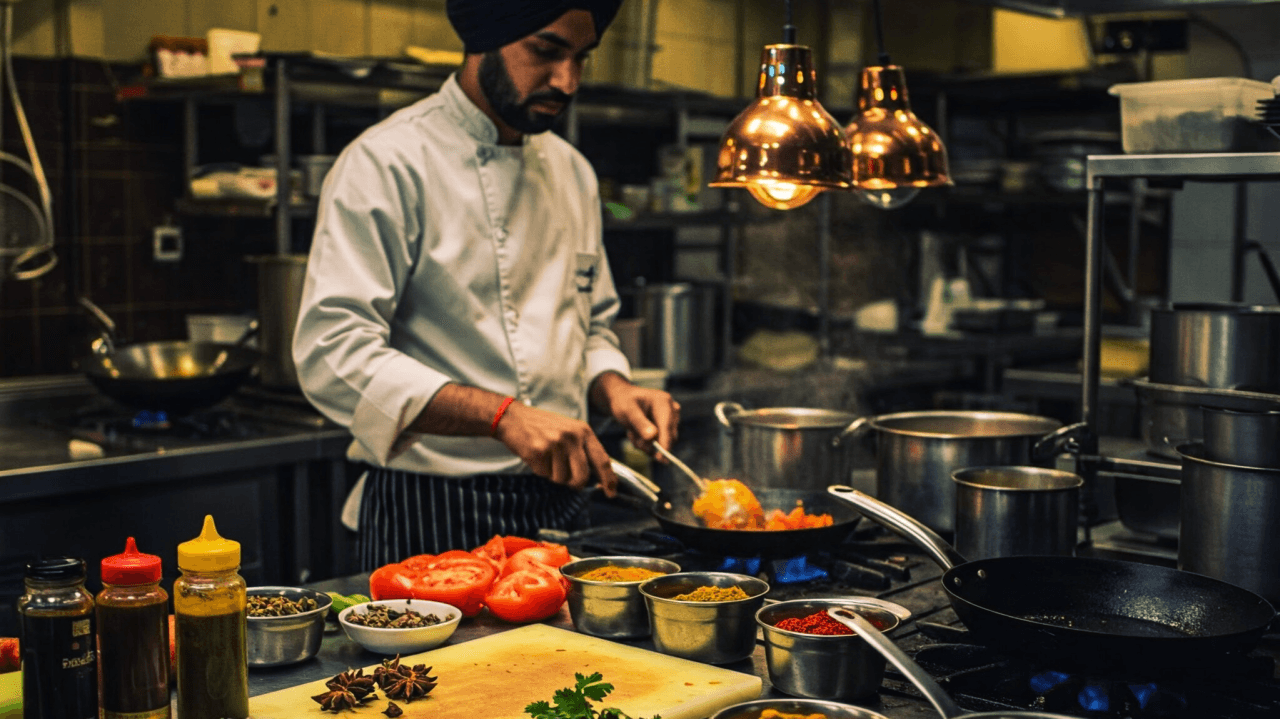
Walk into any British Indian restaurant on a Friday night and you'll witness something genuinely extraordinary — a kitchen producing hundreds of complex, layered dishes in minutes, each one consistent with the last, each one tasting like it took hours. It didn't happen by accident. It took decades.
A cuisine born from constraints
BIR — British Indian Restaurant — cooking is one of the most underappreciated culinary traditions in the world. It emerged in the post-war years as South Asian immigrants, predominantly from Bangladesh and Pakistan, opened restaurants across the UK and faced a specific set of challenges: British diners who wanted Indian food but expected it to arrive quickly, kitchens without the resources for long prep, and a need to serve dozens of different dishes simultaneously from a single brigade.
The solution they developed was nothing short of ingenious. Rather than cooking each dish to order from scratch, they created a system built around pre-prepared bases — onion-tomato gravies simmered for hours, spice mixes balanced to exact ratios, cooked proteins held ready — that could be combined with finishing spices to produce any dish on the menu within minutes.
The base gravy: the foundation of everything
At the heart of BIR cooking is the base gravy — a large-batch sauce typically made from slowly cooked onions, tomatoes, ginger, garlic and a carefully calibrated blend of whole and ground spices. A well-made base gravy is not a shortcut. It is the result of hours of skilled work, and its quality determines the ceiling of every dish it underpins.
When a BIR chef takes a ladle of that base and introduces it to a hot pan with additional whole spices, fresh tomatoes, and finishing spice powders, the transformation happens fast. The intense heat, the bloom of spices, the reduction — it produces a depth of flavour that most home cooks spend hours trying to replicate.
This is the technique that allows a single kitchen to produce a Tikka Masala, a Dhansak, a Madras and a Korma simultaneously, each tasting authentically distinct, each arriving at the table within twelve minutes of being ordered.
Why it matters — and why it's under pressure
BIR cooking created the Indian food culture that Britain knows and loves. It turned regional Indian dishes into a national institution. The chicken tikka masala — debatably a British invention — became the country's most popular restaurant dish for a generation, and the technique behind every version of it is fundamentally BIR.
But the tradition is under serious pressure. The chefs who built this knowledge — who spent years mastering the base gravy, the tempering, the finishing — are ageing out of kitchens. Younger chefs are not replacing them at the same rate. And the economics of running an Indian restaurant have made it harder than ever to justify the prep time that authentic BIR cooking requires.
What it means for modern commercial kitchens
The answer isn't to abandon BIR principles — it's to industrialise the preparation without compromising the standard. The base gravy, done properly, is exactly what a commercial kitchen needs: consistent, scalable, made to the same standard every time.
That's the principle The Fresh Curry was built on. Not to replace skilled chefs, but to capture the thing they do best — the slow, careful work of building a base — and make it available to any kitchen that wants to serve great Indian food without the hours it traditionally demands.
BIR cooking taught us that great Indian food and operational efficiency aren't opposites. The restaurants that figured that out fifty years ago built something that fed a nation. We're just continuing the work.